
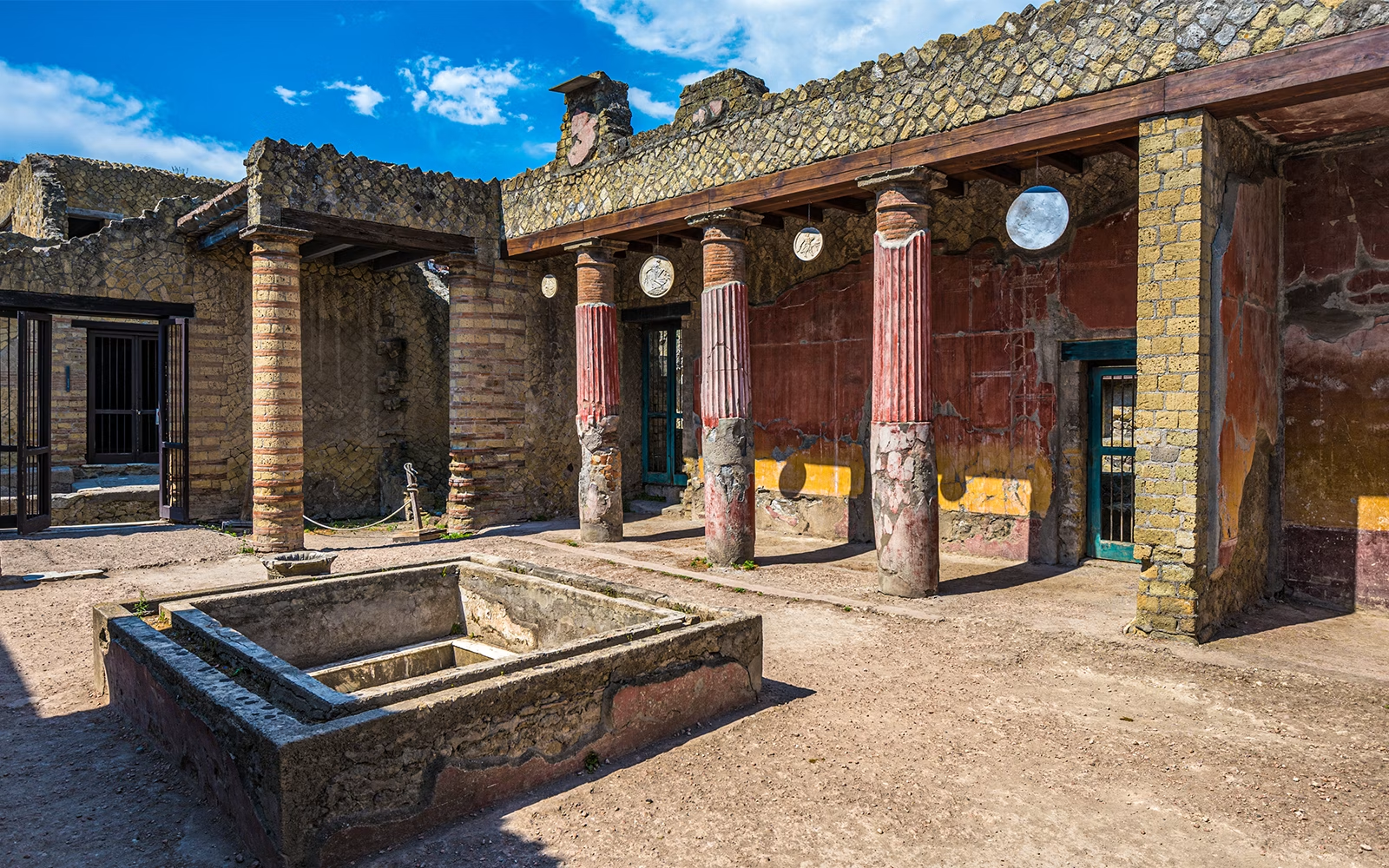
From Samnite town to buried archive
The history of Herculaneum
Herculaneum was a small, wealthy coastal town of some 4,000 people. In a single night in AD 79 it was sealed under twenty metres of volcanic material — and that is precisely why it survived.
Check availability
Available tickets, tours and packages
A selection from our booking partners, with live pricing
Key dates
| Period | Event |
|---|---|
| 6th–4th c. BC | Oscan and Samnite settlement on the coastal spur |
| 89 BC | Herculaneum becomes a Roman municipium |
| AD 62 | A severe earthquake damages the town; repairs are still underway in 79 |
| AD 79 | The eruption of Vesuvius buries the town under pyroclastic surges |
| 1709 | A well strikes the ancient theatre; tunnel excavation begins |
| 1738 onwards | Bourbon excavations under Charles III |
| 1980s | Around 300 skeletons found in the beachfront chambers |
Before the eruption
Set on a promontory between two watercourses, Herculaneum looked directly onto the sea. It had no large industry and no busy commercial artery like Pompeii's Via dell'Abbondanza: it was a residential town, with panoramic houses, well-appointed baths and a compact, orderly street grid.
The earthquake of AD 62 left it in the middle of a long reconstruction. Several houses still show building work in progress at the moment of the eruption — stacked materials, unfinished walls, rooms taken out of use.
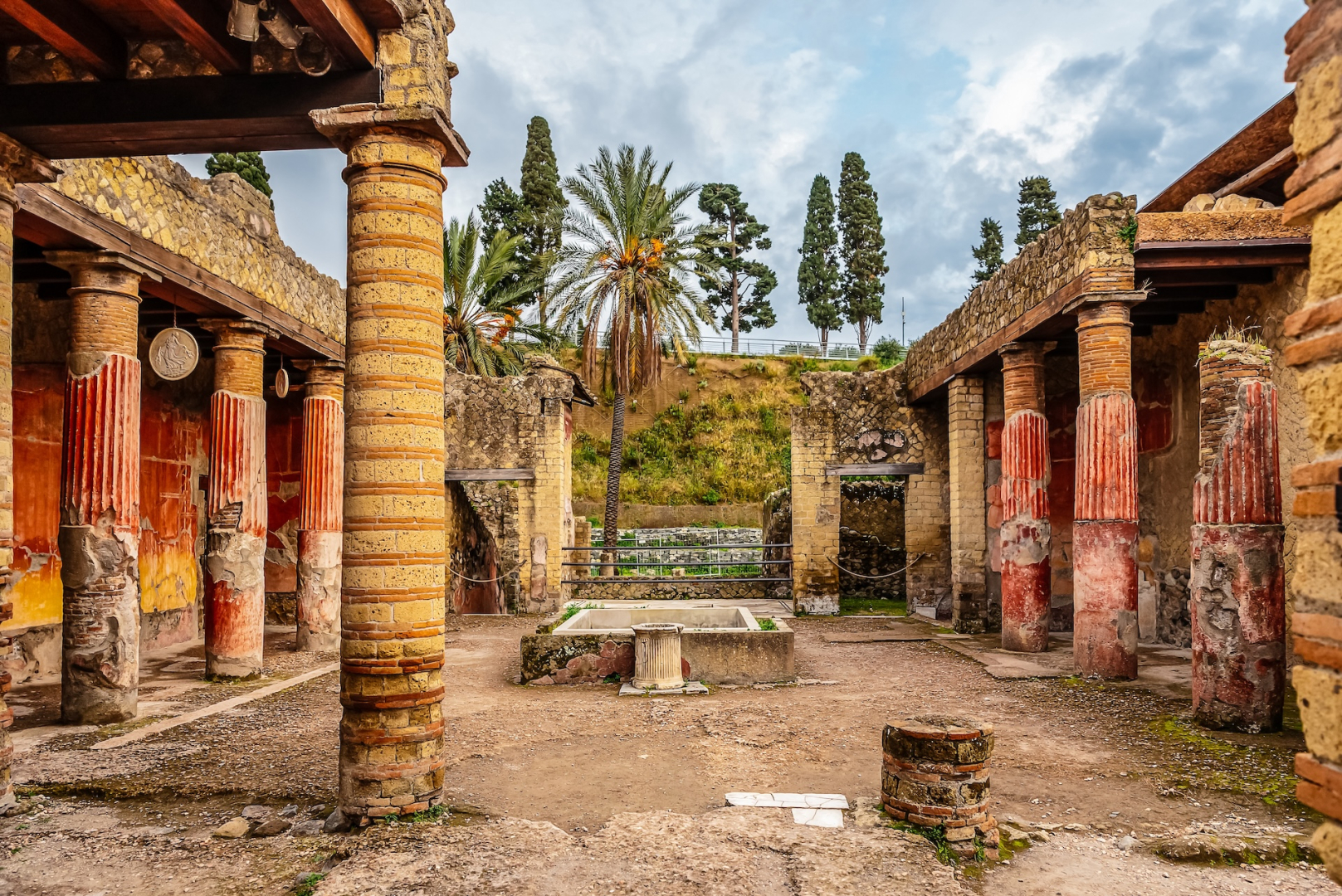
The night of the eruption
Herculaneum lay west of Vesuvius, and the wind pushed the ash column towards Pompeii. Here, almost no pumice fell: what arrived, hours later, were pyroclastic surges — clouds of gas and ash at several hundred degrees, travelling at speed.
- The first surge killed instantly, before the buildings collapsed.
- The extreme heat carbonised wood rather than consuming it, in the absence of oxygen.
- Successive flows filled the town to a depth of about twenty metres.
- The coastline was pushed out several hundred metres: the sea is no longer where it was.
The beachfront chambers
For centuries Herculaneum was thought to have been evacuated in time. Then, in the 1980s, excavation of the boat sheds along the ancient shore uncovered around three hundred skeletons crowded into the vaults: families waiting for a rescue by sea that never came. It remains one of the largest samples of Roman population ever studied.
Rediscovery
Excavation began from below, through tunnels, rather than from the surface. Bourbon engineers pulled out bronzes, marbles and the papyrus rolls of the Villa dei Papiri, then backfilled the galleries. Open-air excavation only started in the 20th century, and today around a quarter of the ancient town is visible — the rest lies beneath modern Ercolano.
Frequently asked questions
How many people died at Herculaneum?
Around 300 skeletons have been found in the beachfront chambers; the total is unknown because much of the town is still buried.
Why is Herculaneum better preserved than Pompeii?
The pyroclastic surges carbonised and sealed organic material, preserving wood, upper floors and furniture.
How big was the town?
Roughly 4,000 inhabitants, far fewer than Pompeii.
Has all of it been excavated?
No — only about a quarter. The modern town sits over the rest.
What is the Villa dei Papiri?
A vast suburban residence whose library of carbonised scrolls is still being read with modern imaging techniques.
Go deeper
Updated 2026-08-04 · Official source