
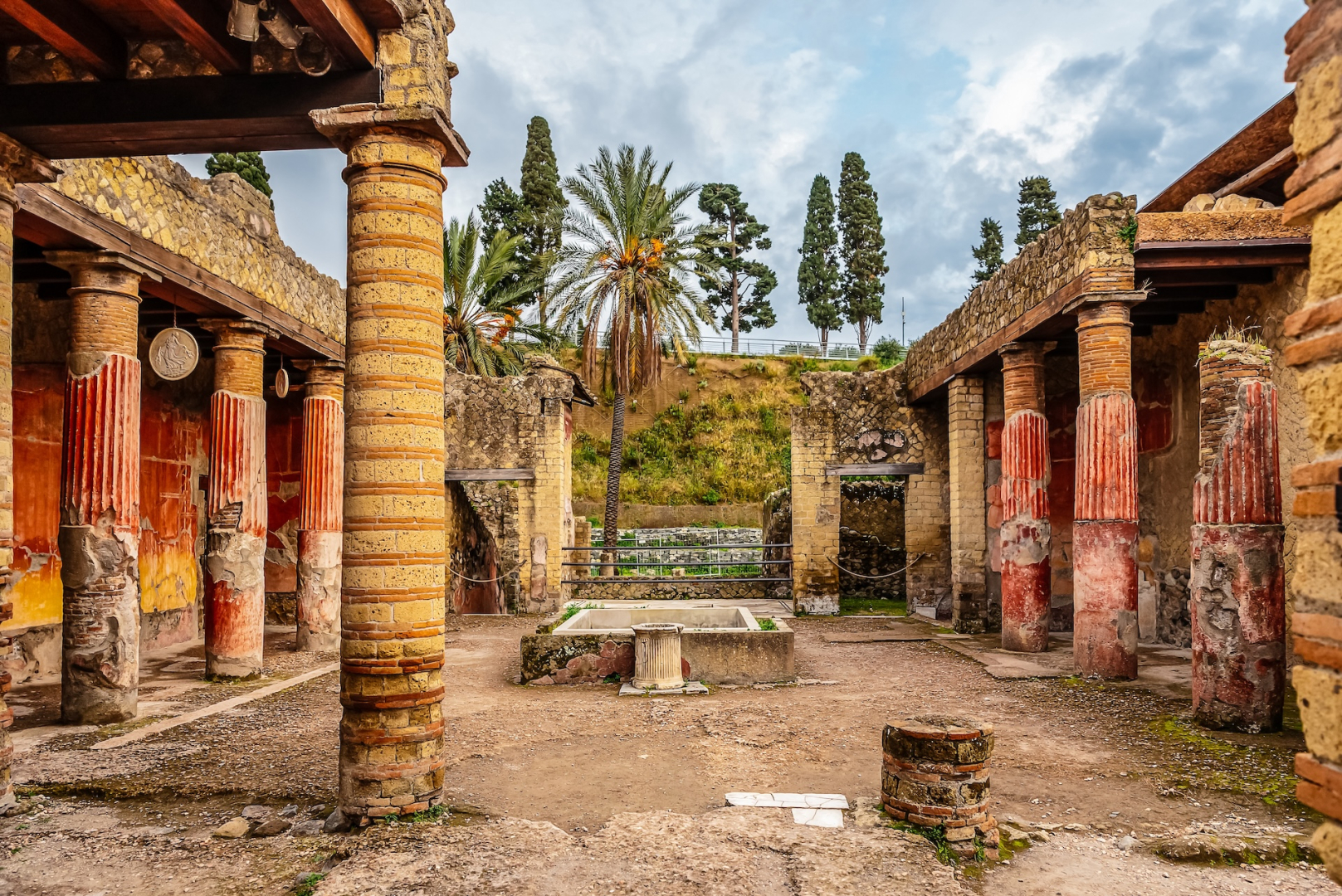
Colour that survived twenty metres of ash
The mosaics of Herculaneum
Herculaneum's mosaics are in place, in the rooms they were made for. That's what makes them different from museum fragments: you see them where a Roman family saw them.
Check availability
Available tickets, tours and packages
A selection from our booking partners, with live pricing
The essential five
| Mosaic | Where | Why it matters |
|---|---|---|
| Neptune and Amphitrite | House of Neptune and Amphitrite | Glass-paste wall mosaic, colours almost intact |
| Nymphaeum with hunting scenes | Same house, adjoining courtyard | Shells, glass paste and marble combined |
| Triton floor | Central Baths, men's section | Black-and-white marine scene, still walkable |
| Geometric floors | Suburban Baths | Optical patterns in black and white |
| Opus sectile floors | House of the Deer | Cut coloured marbles, not tesserae |
Wall mosaic versus floor mosaic
Floors were made to be walked on: dense tesserae, hard stone, usually black and white. Walls could use glass paste — fragile, but brilliant and saturated in colour. Herculaneum has one of the finest surviving examples of the second type, and the difference in colour between the two is immediate.
How to look at them
- 1Step back first: geometric floors are designed to be read whole.
- 2Then get close: you'll see repairs, changes of hand, tesserae of different sizes.
- 3Watch the light: glass paste changes tone completely in the sun.
- 4Look at the thresholds — the mosaic often marks a change of room.
Some rooms are only visible from the doorway to protect the floors. Don't step over the barriers — and don't touch the wall mosaics: glass paste is fragile.
Frequently asked questions
Where is the Neptune and Amphitrite mosaic?
In the house of the same name, on the nymphaeum wall at the rear of the courtyard.
Why are the colours so bright?
It's glass paste rather than stone, and burial protected it from light and weather.
Can you photograph them?
Yes, without flash. Some interiors have their own restrictions.
Are they all visible?
No. Some rooms close for conservation work — check on site which are open.
Are they better than Pompeii's?
Different: Pompeii has more of them, Herculaneum has better-preserved wall mosaics.
Go deeper
Updated 2026-08-04 · Official source